
Property design where the website is the first viewing.
For a nine-figure development, the digital experience is where a buyer decides whether to take the call. We design property platforms that hold attention long enough to produce a qualified enquiry — not a form fill from someone who will never transact.
What luxury property design actually has to solve
Enquiry volume is the wrong metric
A form that anyone can complete in eight seconds produces a pipeline your sales team cannot work. In high-value property the job is qualification, not capture — fewer, better enquiries beat more of them, and the design decides which you get.
Luxury is communicated through restraint
Premium positioning is carried by pacing, typography, whitespace and image quality, not by more features. A site that behaves like an e-commerce listing tells a buyer this is a commodity, whatever the price says.
The assets are enormous
Renders, fly-throughs, floorplates and 4K photography are the product. Presenting them at the quality the property demands while remaining usable on a phone in a lift is a genuine engineering constraint, not a preference.
Gulf markets are not a translation job
Arabic RTL mirrors layout, but numerals, directional icons, floorplan orientation and reading gravity follow their own rules. A mirrored English site is immediately obvious to a native reader — and in a trust-driven purchase, obvious means disqualifying.
What you actually get
Project presentation experiences
Immersive single-property experiences that sequence a buyer through location, architecture, amenity and unit detail in the order that builds conviction rather than the order the brochure happened to use.
Enquiry and qualification journeys
Progressive qualification that filters for intent — budget band, timeline, unit type — without feeling like an interrogation. This is where the 3x qualified-lead improvement at Rcentric came from.
Unit and floorplate explorers
Interactive availability, floorplan comparison and orientation tools that let a serious buyer self-serve the detail they would otherwise need a broker call to obtain.
Asset-heavy performance design
Art direction and loading strategy that preserves render quality while keeping the experience usable on mobile connections — progressive loading, responsive art direction, considered motion.
Arabic RTL and multi-market
Genuine RTL design rather than a mirrored stylesheet, with numerals, iconography and layout gravity handled correctly for UAE and wider Gulf audiences.
Multi-property design systems
A shared system across a developer's portfolio, so each new launch takes weeks rather than months while retaining its own identity — the pattern behind seven Rcentric properties.
How the engagement runs
Positioning
Week 1. Understanding the property, the buyer and the competitive set. A branded residence, an off-plan tower and a completed villa need materially different digital treatments.
Narrative structure
Weeks 2–3. The sequence in which the property is revealed — the single biggest determinant of whether a visitor reaches the enquiry point at all.
Design and art direction
Weeks 3–7. Visual design, motion and asset direction, reviewed against the standard the property itself sets.
Build support
Ongoing. Handover with performance budgets specified, because an asset-heavy experience that loads slowly fails regardless of how it looks in Figma.
Proof
Rcentric — seven luxury properties
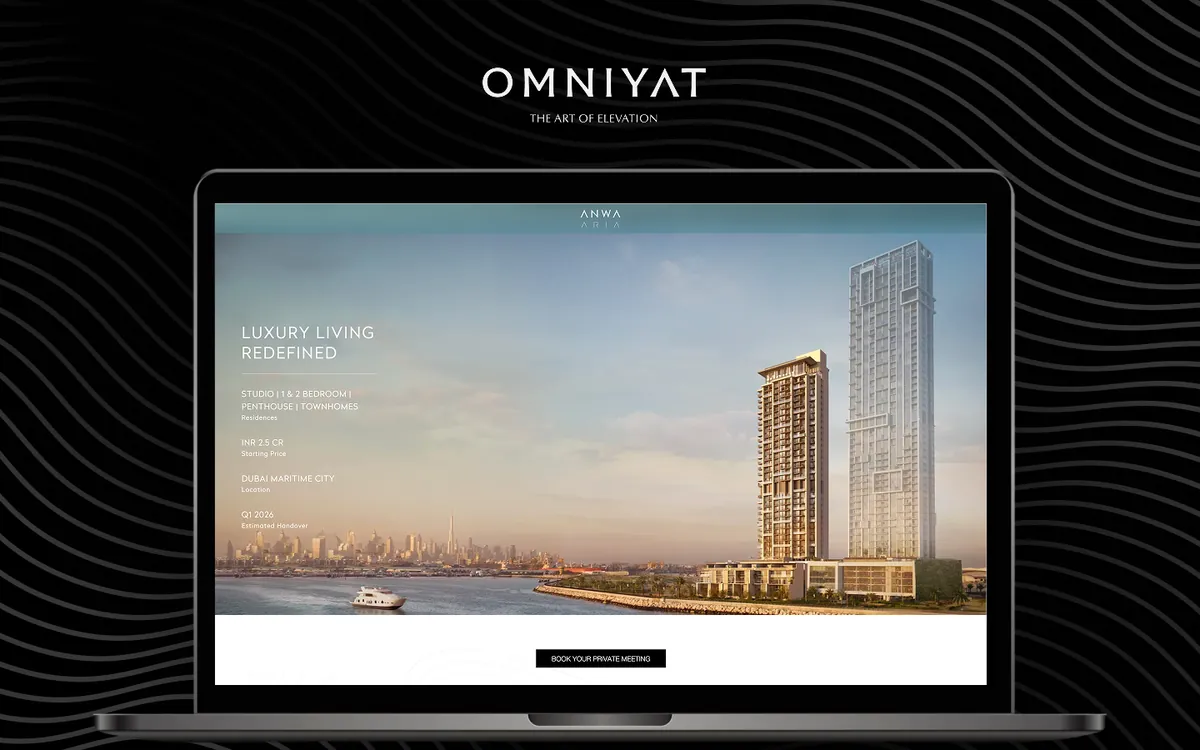
Digital experiences for Omniyat, LIV Residences, Orla Infinity, Opus, Anwa Aria, Ela and Vela Viento. Qualified leads rose 3x and client retention across the portfolio has been 100% — largely because a shared system let each new launch ship quickly without looking templated. Read the full case study →
Related work
Explore the individual properties from the Rcentric case study, or read our guide to Arabic RTL design for Gulf PropTech.
What it costs
How property engagements usually run
Single-property experiences are project-scoped. Developers with a pipeline of launches typically move to a retainer with a shared design system, which is materially cheaper per property from the third one onward. See the pricing page.
Typical timeline
A single property experience runs 6–8 weeks. Subsequent properties on an established system are usually 3–4.
Common questions
By designing the enquiry journey as progressive qualification rather than a single form. Serious buyers will answer questions about budget band, timeline and unit preference if those questions are sequenced sensibly and clearly justified; casual browsers will not. That self-selection is the mechanism — at Rcentric it produced a 3x increase in qualified leads without a proportional increase in raw volume.
Yes, and properly. RTL is a structural design task rather than a stylesheet flag — layout mirrors, but numerals stay left-to-right, directional icons need individual decisions, floorplan orientation carries its own conventions, and the visual centre of gravity shifts. A naively mirrored English site is immediately recognisable to a native reader, which in a trust-driven purchase is disqualifying.
By treating performance as an art-direction decision rather than a build afterthought. That means responsive art direction so mobile gets a genuinely different crop rather than a scaled-down 4K file, progressive and prioritised loading so the hero resolves before the gallery, and motion that is specified with a frame budget. We hand over performance budgets with the design.
Both, though they are different problems. Developer work is single-property narrative — one asset, deep storytelling, conviction-building. Brokerage work is inventory, search and comparison at scale. We have done more of the former; if you are a brokerage, say so early because the architecture question dominates.
That is the most efficient way to work with us. A shared design system means each launch retains its own identity while reusing the structural work — the pattern behind seven Rcentric properties, and the reason per-property cost falls significantly from the third onward.
Yes — listing platforms, property management tools and investment products are closer to our B2B SaaS work in structure, and we approach them that way: workflows, dashboards and data density rather than narrative and art direction.
Is your project site producing qualified enquiries?
Thirty minutes. We'll tell you where the enquiry journey is leaking and whether the problem is presentation, qualification, or the form itself.