
In-car design where a second of attention is the budget.
Automotive HMI is the one place where an interface decision has a physical safety consequence. We design infotainment and cluster experiences around glance duration and cognitive load — constraints that make most conventional UI thinking actively wrong.
Why automotive HMI breaks normal design rules
Attention is borrowed, not given
Every glance at a screen is attention taken from the road. Guidance converges on roughly two seconds per glance — a budget that invalidates most patterns designed for people looking directly at a device.
The user is physically moving
Vibration, changing light, gloved or occupied hands, and peripheral vision only. Touch targets, contrast and motion tolerances that pass on a desk fail comprehensively at 80km/h.
Hardware is fixed years ahead
Screen size, resolution, processing budget and physical control layout are locked long before design starts and cannot be revised. Designing as though a spec change is available is how automotive projects fail late and expensively.
Safety-critical and comfort share a screen
Speed, warnings and ADAS status sit alongside media and climate. The hierarchy between what a driver must see and what they might want is a safety decision expressed as a layout.
What you actually get
Digital instrument cluster design
Speed, range, warnings and ADAS state designed for peripheral legibility and immediate comprehension — the information a driver must absorb without deliberate reading.
Infotainment system design
Navigation, media, climate, connectivity and vehicle settings structured so common tasks resolve within a safe glance budget rather than requiring sustained attention.
Glance-load analysis
Task-by-task assessment of how long each interaction takes and how many glances it costs, so distraction is measured during design rather than discovered in validation.
Day, night and adverse-condition states
Full state design across lighting conditions and glare, where contrast requirements differ sharply from any screen used indoors.
Multi-modal interaction
Coherent behaviour across touch, physical controls, steering-wheel input and voice, so a driver can complete a task by whichever route their hands and attention currently allow.
Design systems for vehicle ranges
A consistent HMI language across trim levels and model years, adapting to different screen hardware without redesigning from scratch for each variant.
How the engagement runs
Constraints first
Weeks 1–2. Hardware specification, regulatory context, physical control layout and driving contexts. In automotive the constraints define the design space far more tightly than user preference does.
Task and glance modelling
Weeks 2–4. Mapping every driver task against the attention it costs, and prioritising what belongs on screen at all versus what belongs on a physical control.
Design and simulate
Weeks 4–10. Interface design validated in driving-simulator conditions rather than on a monitor, because desk evaluation systematically underestimates glance cost.
Handover
Ongoing. Specifications detailed enough for embedded engineering teams, including behaviour under degraded conditions and hardware constraint.
Proof
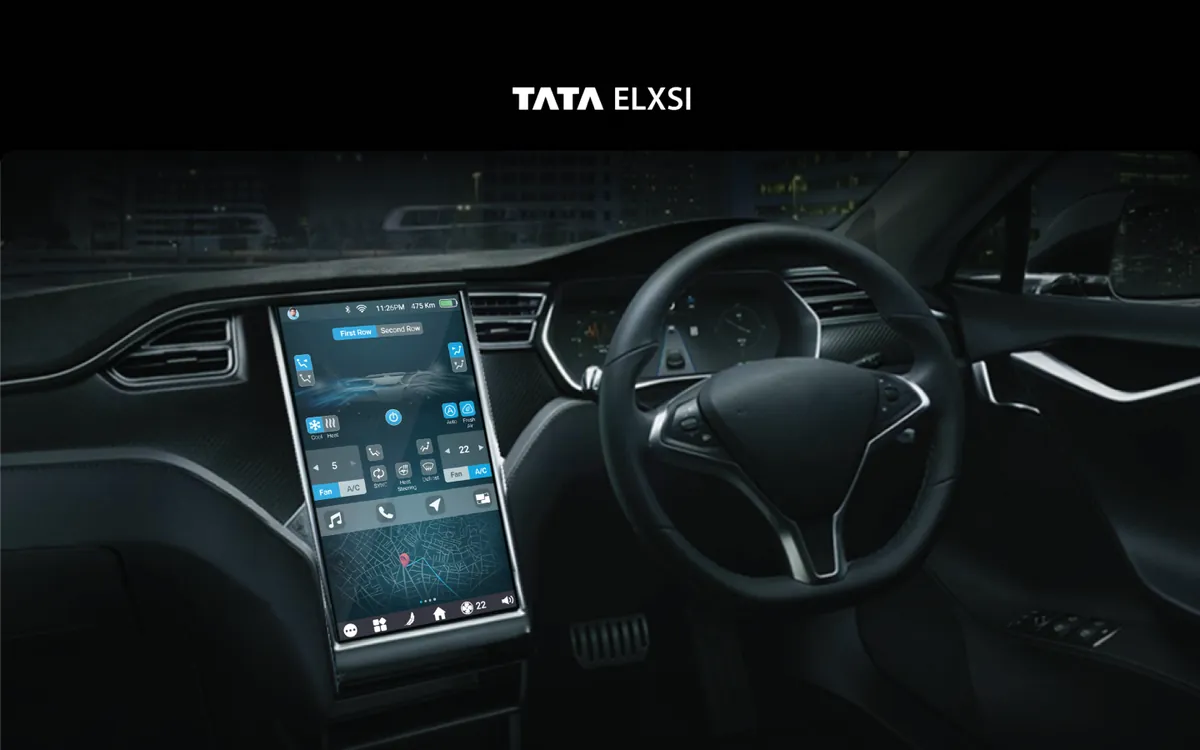
Tata Elxsi — two in-car HMI systems
An infotainment interface and a digital instrument cluster designed for connected vehicles, working within a tier-one supplier's engineering constraints. Driver distraction fell 30% — the clearest evidence we have that interface design is an engineering discipline with measurable physical outcomes. Read the full case study →
Related work
See the infotainment and instrument cluster case studies. The same constraint-first approach informs our product design practice.
What it costs
How automotive engagements run
Automotive projects are project-scoped with longer timelines than equivalent software work, because hardware constraints, validation cycles and supplier review add stages that cannot be compressed. We scope for that rather than discovering it midway. See the pricing page.
Typical timeline
A single HMI surface typically runs 8–10 weeks. A full cluster plus infotainment programme is a multi-month engagement with validation gates built in.
Common questions
By treating glance duration as the primary design budget. Industry guidance converges on roughly two seconds per glance and a limited total for any single task, so we model each task's glance cost during design rather than discovering it in validation. Practically this means larger type than feels necessary, fewer simultaneous decisions, information positioned for peripheral pickup, and moving genuinely frequent actions to physical controls where possible. At Tata Elxsi this approach reduced measured distraction by 30%.
Always — in automotive that is the job. Screen size, resolution, processing budget and physical control layout are typically locked years before design begins. Designing as though a hardware revision might be available is the most common way automotive design programmes fail expensively and late. We start from the specification sheet.
Yes, and we have done both. They are genuinely different problems: a cluster is glanceable, safety-critical, largely non-interactive and must be legible in peripheral vision, while infotainment is interactive and task-based. The hard part is making them feel like one coherent system while respecting that the cluster's job is fundamentally different.
In driving-simulator conditions rather than on a desk. Desktop evaluation systematically underestimates glance cost, because a seated designer with full attention and no vibration is not the user. Where you have simulator access we design against it; where you do not, we model glance load analytically and flag the tasks most in need of physical validation.
Yes, through Tata Elxsi. It matters more than it might sound: automotive programmes carry review gates, documentation standards and engineering handover expectations that are far heavier than consumer software, and a design team unfamiliar with them creates schedule risk regardless of design quality.
Range, charging state and energy flow are the defining EV information problems, and they carry an anxiety dimension that fuel gauges never did. Range confidence is largely a design outcome — how estimation uncertainty is communicated, how charging is planned, how regeneration is made legible. We treat it as a trust problem as much as a data-display one.
Designing an in-car experience?
Thirty minutes on your HMI concept — glance load, interaction cost, and what we'd change before it reaches a driving simulator.